
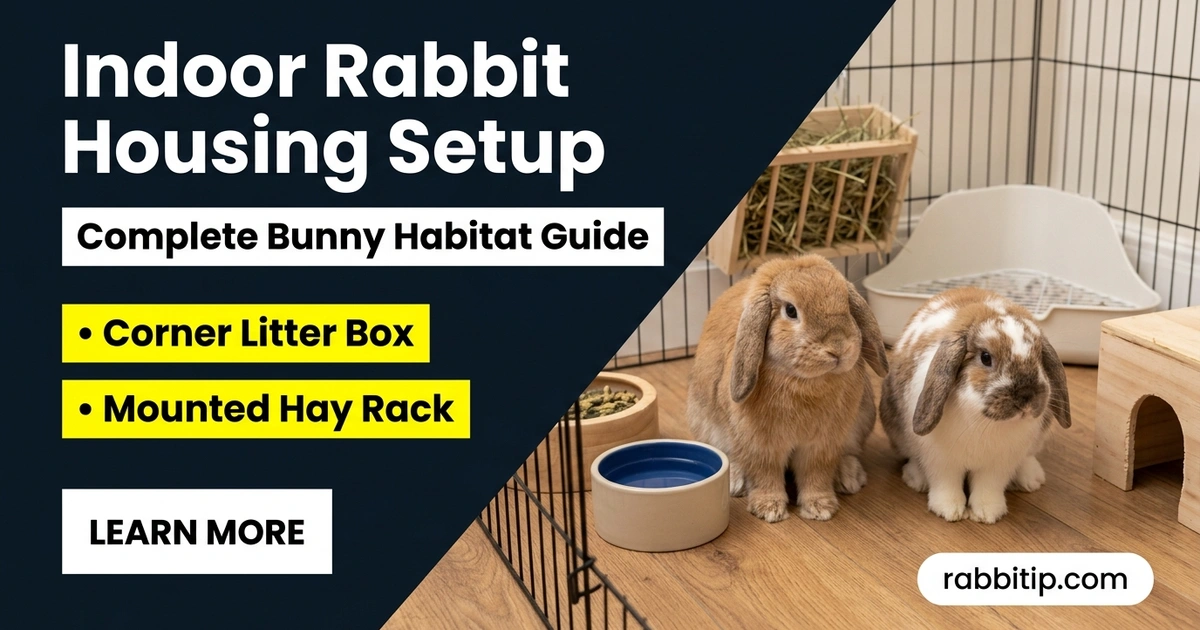
Most rabbit owners start with a pet store cage. It looks fine, and the box says it works. But it is almost never big enough. A small cage is the most common mistake new owners make. It leads to boredom, sore feet, weight gain, and gut problems.
This rabbit housing setup guide covers everything. You will learn how to measure your space and pick the right enclosure. You will also learn how to lay bedding, hang a hay rack, and place tunnels. If you are getting your first rabbit or a bonded pair, read about the 3-3-3 rule for settling rabbits in. It tells you what to expect when your rabbit arrives home.
By the end of this guide, you will have a clear plan. Your rabbit will have a home where it can truly thrive.
Why Proper Rabbit Housing Matters
Bad housing does not just make a rabbit sad. It makes them sick. Research from NC3Rs shows that rabbits in small spaces show much higher rates of stress behaviors. These include circling and bar chewing. A stressed rabbit is also more likely to get GI stasis in rabbits. This is a dangerous gut slowdown. It sends many rabbits to the emergency vet each year.
Rabbits are prey animals. They hide pain and illness well. Watching rabbit body language signals gives you early warning signs. But the best approach is to build a good home from the start.
Good housing helps in three ways. It gives room to move for physical health. It provides hiding spots for mental health. And it allows safe time with people and other rabbits for social health. Get the space right and the rest becomes easier.
Minimum Space Requirements for Rabbits
The most important number in this guide is floor space. The Rabbit Welfare Association and Fund says a rabbit needs at least 3 meters by 2 meters. That is about 10 feet by 6.5 feet. Most pet store cages offer only a small part of that.

Space Standards for One Rabbit vs a Bonded Pair
The House Rabbit Society says the sleeping area needs at least 8 square feet. But the sleeping space is not the same as the exercise space. Your rabbit needs access to both. The total combined space must meet the full 3m x 2m standard.
A quick test is the “3 hops” rule. Put your rabbit in the pen and watch it move. It should hop three full times in a row without hitting a wall. If it cannot, the space is too small. For a rabbit housing setup guide for 2 rabbits, add at least 50% more floor space. Bonded pairs need room to move apart when needed.
Sizing by Breed: Dwarf, Medium, and Giant
The “1 square foot per pound” rule is a rough guide. It often underestimates big breeds. It can also mislead owners of small breeds. Use the table below for better targets by breed size. For very large breeds, check the dedicated cage sizing for Flemish Giants guide for exact build sizes.
One key note on height: rabbits binky when happy. They jump straight up with a full twist. Your enclosure must be tall enough for this. Your rabbit should not hit the ceiling.
Use this table when shopping or building.
← Scroll to see more →
| Rabbit Size Category | Example Breeds | Min Floor Area (ft²) | Min Floor Area (cm²) | Min Length | Min Height |
|---|---|---|---|---|---|
| Dwarf (under 3.5 lbs) | Netherland Dwarf, Polish | 8 ft² | 7,432 cm² | 4 ft / 122 cm | 24 in / 61 cm |
| Small (3.5–5 lbs) | Holland Lop, Mini Rex | 12 ft² | 11,148 cm² | 5 ft / 152 cm | 24 in / 61 cm |
| Medium (5–8 lbs) | Rex, New Zealand White | 16 ft² | 14,864 cm² | 6 ft / 183 cm | 30 in / 76 cm |
| Large (8–12 lbs) | French Lop, English Lop | 20 ft² | 18,580 cm² | 7 ft / 213 cm | 36 in / 91 cm |
| Giant (12 lbs+) | Flemish Giant, Checkered Giant | 30 ft² | 27,870 cm² | 8 ft / 244 cm | 36 in / 91 cm |
Types of Rabbit Housing Compared
Picking the right enclosure is not just about cost. It depends on your home, your rabbit’s size, and your long-term space. Each type of housing has its own pros and cons.
Indoor Cages and Exercise Pens
A wire cage can work as a sleeping den. But it should never be the only space. A better indoor option is an x-pen. This is a folding wire panel system. You can shape it into any layout. Even better is a C&C pen. It uses wire grid panels and a coroplast base. C&C setups cost less per square foot than most cages. You can also expand them as your rabbit grows.
For tips on setting these up in a small space, the indoor rabbit cage setup guide covers room layouts and floor protection options. Note that any panel gap wider than 1.5 inches needs a second barrier. Rabbits can squeeze through smaller gaps than you expect.
Outdoor Wooden Hutches and Runs
An outdoor wooden rabbit hutch gives your rabbit fresh air and light. A well-built one with a full attached run can meet space needs. But weather protection is a must. The hutch needs waterproofing, winter insulation, and summer airflow panels. The run must have a dig-proof base. Use concrete slabs, paving stones, or wire mesh buried at least 12 inches down.
Predator safety is also critical. Foxes, raccoons, and large birds can reach through standard mesh. Use 16-gauge welded wire or hardware cloth. Gaps must be no wider than 1 inch. The wooden rabbit hutch guide covers all the build and safety details. Always use bolt-snap locks. Simple clips can be nudged open by predators.
Free-Roam Setups
Free-roaming means your rabbit moves through a full room or home. This is the best setup for rabbit welfare. But it needs two things first. Your rabbit must be litter-trained. And the space must be fully bunny-proofed. A hybrid approach works well for many owners. Your rabbit has a home base pen. Then it gets access to other rooms during active hours.
Indoor vs Outdoor Housing: Which Is Better?
Indoor housing is safer for most rabbits in most cases. PetMD notes that indoor rabbits get better vet care. They are safe from extreme heat and cold. They also face less stress from predators. Predator stress alone can cause fatal heart attacks in prey animals.
Outdoor housing can still work if done right. A solid outdoor run with a connected hutch, good predator protection, shade, and winter cover can meet welfare needs. The key factors are your climate and how much time you can give.
Here is a direct comparison.
← Scroll to see more →
| Factor | Indoor | Outdoor |
|---|---|---|
| Predator risk | Very low | High without hardware mesh and bolt locks |
| Temperature control | Easy | Requires seasonal modification |
| Socialization with family | High — rabbit integrates into daily life | Lower — requires deliberate interaction visits |
| Vet access | Easy to observe symptoms | Symptoms often noticed later |
| Space potential | Limited by indoor room size | Larger runs possible in garden |
| Cost | Moderate | Higher initial build cost for safe setup |
| Fly strike risk | Very low | High in summer without daily checks |
If you live where winters are cold or summers are hot, indoor housing removes the biggest risks. If you have a large secure yard and can visit twice a day, a good outdoor setup can work. But never leave a rabbit alone outdoors for days at a time.
Essential Supplies and Step-by-Step Setup
Getting supplies ready before your rabbit arrives makes everything easier. The wrong items can cause real health problems. Take your time with this list.
Flooring, Bedding, and Litter Box
Wire-bottom floors are one of the most harmful choices for rabbits. Constant wire contact causes sore hocks. This is a painful open sore on the heel. It can get infected and is hard to treat. Always use solid flooring. Safe options include:
Fleece liners placed over a solid base (easy to wash, no loose bits)
Paper-based bedding such as Carefresh (soft, absorbent, low dust)
Kiln-dried pine shavings as a safe wood option (never use cedar or regular pine, as both release harmful fumes)
Hay as a bedding layer in the sleeping area, which also gives your rabbit something to chew
The litter box should be a rectangle. It must be big enough for your rabbit to turn around fully. A corner litter box is too small for most breeds. Fill it with paper-based litter and add a top layer of hay. This gets your rabbit to eat and toilet in the same spot. You will have much better results if you litter train your rabbit before giving them full room access.
Food Stations, Water, and Hay Access
Hay makes up 80% of your rabbit’s diet. So the hay rack is the most important item in the setup. Mount it at nose height. Your rabbit should pull hay out easily without reaching up or digging through a floor pile. A mounted rack also keeps hay cleaner.
For water, use a heavy ceramic bowl. Bottles can have air locks and give uneven flow. Rabbits drink more freely from open bowls. Use a bowl heavy enough that your rabbit cannot flip it. Place the pellet dish away from the litter box and hay rack. This creates clear feeding zones your rabbit will quickly learn.
Hides, Shelters, and Resting Platforms
The RSPCA (rspca.org.uk) says every rabbit needs at least two separate hiding spots. These should be fully enclosed so your rabbit feels safe inside. A rabbit with nowhere to hide stays anxious all the time. Wooden hide boxes, cardboard tunnels, and fabric dens all work. Just make sure any wood is untreated and safe for rabbits.
Raised platforms add usable space and give your rabbit a lookout point. Even a simple wooden shelf raised 6 to 8 inches off the ground works well. Rabbits naturally seek higher ground to watch for danger. Platforms meet that need and create a second level in the enclosure.
Enrichment and Exercise Area Design
A rabbit that sits still all day is not relaxed. It is bored. The RSPCA says rabbits need at least three hours of active movement each day. The habitat must support that, not block it.
Toys and Mental Stimulation
Chewing is a basic need for rabbits. Their teeth grow all the time. Gnawing keeps teeth at the right length. Fill your enclosure with safe chew toys for rabbits. Use untreated willow, apple wood, or hay-based pressed toys. Rotate them every few days to keep things fresh.
You can also add:
Digging boxes filled with shredded paper or soil (great for rabbits who dig at carpet)
Cardboard tunnel systems that link different zones of the enclosure
Puzzle feeders that make your rabbit work for pellets or herb treats
Hanging herb bundles of dried chamomile, rosehip, or lavender for nose enrichment
Picture your rabbit waking up at dusk, when rabbits are most active. It finds a fresh willow stick in its tunnel and a new cardboard box to check out. This kind of low-cost rotation keeps a rabbit sharp and happy. And it needs very little effort from you.
Exercise Pen Layout and Free-Roam Time
The exercise pen should connect directly to the main enclosure. Use a hinged panel or matching clip so your rabbit can move between spaces freely. Three hours is the daily minimum, but many owners just leave the pen attached all day and let the rabbit decide when to explore.
For supervised time outside the pen, a rabbit exercise pen setup works well as a room divider during the first weeks. Never leave a new rabbit alone in a fully open room until you have checked all the bunny-proofing. Rabbits are fast and will find the one cable you missed.
Bunny-Proofing Your Home or Yard
You will not be able to train chewing away fully. The better plan is to remove what your rabbit can reach and protect what you cannot move. To stop your bunny from chewing everything in a free-roam space, get on your hands and knees. Look at the room from rabbit height.
Indoors, cover or move:
All electrical cables (use split wire loom tubing or cable boxes)
Baseboards and door frames (clear plastic corner guards or untreated wood blocks work as decoy chew spots)
House plants, as many common types like pothos, ivy, and lilies are toxic to rabbits
Small gaps behind appliances, under sofas, or between shelving units
Outdoors, protect against:
Digging: bury hardware mesh 12 inches underground around the run
Climbing predators: add an inward-angled overhang to the top of any open run
Small gaps: use hardware cloth with gaps no larger than 1 inch
Balcony or deck edges: use solid wooden panels, not rails a rabbit can wedge through
Here is a real example. Your rabbit finds a gap behind the washing machine while you are in another room. In 10 minutes, it chews through a rubber drain hose. This is not rare. It is one of the most common emergency vet calls rabbit owners report. One walk-through with a flashlight and a roll of cable cover takes 20 minutes. It prevents this entirely.
Cleaning and Maintenance Schedule
The PDSA (pdsa.org.uk) says dirty bedding and a neglected litter box are top causes of bacterial infections and fly strike in rabbits. Fly strike is when flies lay eggs in soiled fur. It can become fatal within 24 hours. A steady cleaning schedule is the easiest way to prevent it.
Here is a schedule that keeps things safe:
Daily tasks:
Remove soiled hay from the litter box and add a fresh top layer
Spot-clean wet or soiled bedding
Wipe down food and water bowls
Check the water bowl and refill
Weekly tasks:
Empty the litter box fully, wash it with white vinegar, and refill
Remove and wash fleece liners or replace paper bedding fully
Wipe down enclosure panels and platform surfaces
Check wooden hides and toys for splinters or damage
Monthly tasks:
Deep-clean the full enclosure floor with a rabbit-safe cleaner (avoid bleach and pine-based products)
Check all panel clips, latches, and connections for wear
Rotate or replace enrichment items
Skip any cleaner that has phenols, essential oils, or citrus compounds. These are toxic to rabbits even in small amounts.
DIY Rabbit Housing Ideas on a Budget
Rabbit enclosures that meet welfare standards often cost $200 to $400 or more. But you can build a better setup for much less. The community site binkybunny.com has shared hundreds of owner builds. The most popular is the NIC grid or C&C pen.
A basic C&C enclosure uses:
NIC wire grid panels: about $30 to $50 for a pack that builds a 4-panel by 2-panel floor plan
Coroplast (corrugated plastic sheet): $15 to $25 for a floor tray to hold litter and bedding
Zip ties and cable connectors: under $10
Total cost for a starter pen: $55 to $85. You can add panels over time. This makes it the most flexible budget option. And the grid spacing is fixed, so there are no hidden sizing problems.
Other low-cost options include:
Repurposed bookshelves turned into a hutch with added wire panel fronts and a removable litter tray at the base
Outdoor pallet hutches (use only untreated pallets; pallets marked MB were treated with methyl bromide and must never be used for animals)
For outdoor DIY builds, treated lumber is fine for the outer frame. But any surface your rabbit touches directly should use untreated wood or a safe lining.
Common Rabbit Housing Mistakes to Avoid
These are the errors seen most often in rescue notes, welfare forums, and vet reports. Check your setup against this list before your rabbit comes home.
Using a pet store cage as the only enclosure — almost all are too small by welfare standards
Wire-bottom flooring without a solid mat — causes sore hocks within weeks
Cedar or regular pine shavings — harmful compounds damage the liver and lungs
No second hiding spot — one hide is not enough; rabbits need options
Zero daily exercise time — three hours is the minimum, even for small breeds
Glass tanks or solid-sided boxes — poor airflow leads to heat buildup
Direct sunlight with no shade — rabbits overheat fast above 25 degrees C (77 degrees F)
Isolating a rabbit with no social contact — rabbits are social and suffer alone
Frequently Asked Questions
How much space does one rabbit need?
The Rabbit Welfare Association and Fund says one rabbit needs at least 3 meters by 2 meters. That is about 10 feet by 6.5 feet. This includes a sleeping area of at least 8 square feet plus a linked exercise zone. This is a minimum. More space is always better.
What is the best flooring for a rabbit enclosure?
Solid flooring with fleece liners or paper-based bedding like Carefresh is the safest choice. Wire-bottom floors cause sore hocks. This is a painful sore on the heel pad. Never use cedar or regular pine shavings. Both release compounds that harm rabbit lungs and liver over time.
Can two rabbits share the same enclosure?
Yes, bonded pairs can and should share a habitat. Rabbits are very social. Paired rabbits show lower stress and better health than lone rabbits. The enclosure should be at least 50% larger than the single-rabbit minimum. Each rabbit needs space to retreat when needed.
How many hours of exercise does a rabbit need daily?
The RSPCA recommends at least three hours of active exercise per day. This should include room to run, jump, dig, and forage. An attached exercise pen your rabbit can access freely is the easiest way to meet this need each day.
Is an outdoor hutch safe for rabbits year-round?
An outdoor hutch can be safe year-round with the right setup. In summer, add airflow panels, shade, and frozen water bottles to prevent overheating. In winter, add insulation, a windbreak, and a covered run. Do not leave rabbits outdoors when temps drop below 10 degrees C (50 degrees F) without proper cover. Never leave them during frost or snow without a fully sheltered space.
What bedding should I use in a rabbit litter box?
Paper-based litter such as Carefresh, Yesterday’s News, or pressed paper pellets is the safest choice. Add a layer of fresh hay on top. This gets your rabbit to eat and toilet in the same spot, which is natural behavior for them. Avoid clay litters, clumping litters, and any scented or deodorizing products. Rabbits groom themselves and swallow anything they touch.
How often should I clean a rabbit enclosure?
Spot-clean soiled litter and wet bedding every day. Do a full litter box change and wipe-down each week. Once a month, deep-clean the whole floor area with a rabbit-safe cleaner. White vinegar mixed 1:1 with water is safe and works well. Also check all parts of the structure for wear or damage.
Your 7-Step Setup Checklist Before Your Rabbit Comes Home
Good rabbit housing is the most important decision you will make as a rabbit owner. Get the space, supplies, and enrichment right from day one. Your rabbit’s health and lifespan depend on it.
Here is the full setup list:
Space: Confirm your enclosure meets the 3m x 2m minimum for one rabbit, more for two
Enclosure type: Choose the setup that fits your home (x-pen, C&C, free-roam, or hutch)
Flooring and bedding: Solid base, safe litter, and a correctly sized litter box
Food stations: Nose-height hay rack, ceramic water bowl, and a separate pellet dish
Enrichment: At least two hides, a chew item, and one digging or puzzle toy
Bunny-proofing: Cables covered, toxic plants removed, and all gaps blocked
Maintenance schedule: Daily, weekly, and monthly tasks written down and ready to follow
For full day-to-day care beyond the habitat, read the complete bunny care sheet. And if you are setting up an indoor space, the indoor rabbit cage setup guide goes deeper on room layouts, panel setup, and floor protection for different surfaces.
